How to play Rummy: rules, scoring and every major variant
Quick start: play tonight with a real deck
- What you need
- One standard 52-card deck with the jokers taken out, 2 to 6 players, and a pen and paper.
- The deal
- 10 cards each for 2 players, 7 each for 3 or 4, and 6 each for 5 or 6. Flip the next card face up to start the discard pile. The rest is the stock.
- A turn
- Draw the top card of the stock or the discard pile.
- Lay down any sets or runs, and add to melds on the table.
- Discard one card face up.
- How to win
- Be the first to get rid of every card in your hand.
- Scoring
- The winner scores the cards left in everyone else's hands: face cards 10, aces 1, other cards their number.
What Rummy is
“Rummy” is the name of one game and also of a whole family of them. The basic game on this page is the one most Americans learned from a grandparent: one deck, a short hand, melds on the table and a race to empty your hand. Gin Rummy, Rummy 500, Indian 13-card Rummy, Canasta and the tile game sold as Rummikub all grew from the same idea of drawing and discarding until your cards form combinations.
Rules vary from table to table more than in most card games. Where groups commonly disagree, this page says what the standard rules are, following pagat.com, the main reference for card game rules, and then lists the usual house rules so your table can pick one before the first deal.
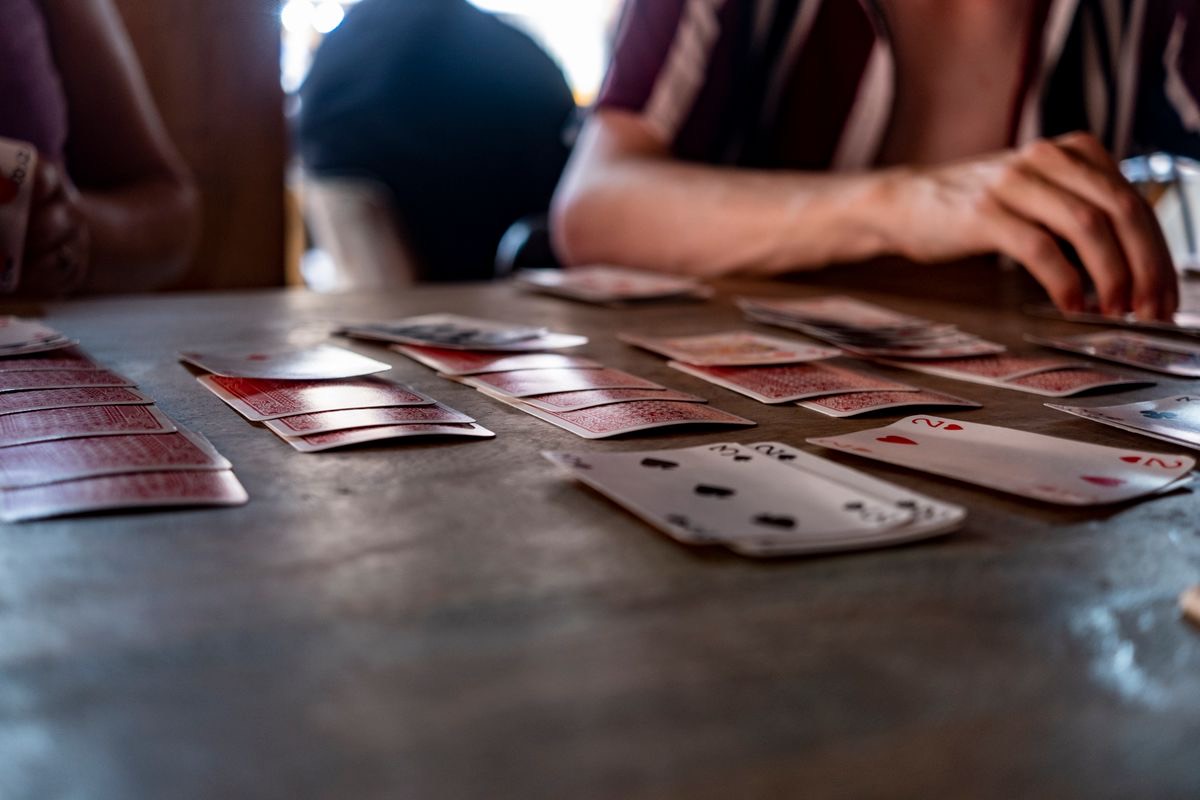
Players, deck and deal
Players: 2 to 6. It plays best with 2, 3 or 4.
Deck: one standard 52-card deck, no jokers. Cards rank from ace (low) up through 2, 3 and so on to 10, jack, queen and king.
Choosing the dealer: anyone can deal first. With two players the deal alternates. With more, it passes to the left after each hand.
The deal: shuffle and deal cards one at a time, face down, starting with the player on the dealer's left.
| Players | Cards each |
|---|---|
| 2 | 10 |
| 3 or 4 | 7 |
| 5 or 6 | 6 |
Put the rest of the deck face down in the middle. That's the stock. Turn its top card face up next to it to start the discard pile. With 7 or more players, shuffle two decks together and deal 7 cards each, or switch to Rummy 500 or Contract Rummy, which are built for bigger groups.
Agree before you start how long you'll play: a target score, or a set number of hands.
A turn
The player to the dealer's left goes first (with two players, the non-dealer). Play moves to the left. Every turn has the same steps, in this order:
- Draw one card. Take the top card of the stock without showing it, or take the face-up top card of the discard pile. You must draw.
- Meld, if you want to. Lay a set or run from your hand face up on the table in front of you.
- Lay off, if you want to. Add cards from your hand to any meld already on the table, yours or anyone else's.
- Discard one card. Put a card face up on top of the discard pile. That ends your turn.
One rule catches new players: if you took the top discard, you can't throw that same card back on the same turn. You can discard it on a later turn. A card you drew from the stock can be discarded right away.
Pagat's standard rules allow one meld per turn, plus as many lay-offs as you like. Most American families and most rule booklets let you lay down as many melds as you have in a single turn. Pick one; this guide assumes the second because it's what most people expect.
Melds: sets and runs
A meld is a group of cards you lay face up on the table. There are two kinds.
Sets
A set (also called a group or a book) is three or four cards of the same rank.
Runs
A run (also called a sequence) is three or more cards of the same suit in order. A run can be as long as you like.
Cards of mixed suits don't make a run. 4 of hearts, 5 of spades and 6 of hearts is not a meld.
Where the ace goes
In standard Rummy the ace is always low. A-2-3 of a suit is a run, and Q-K-A is not.
A very common house rule lets the ace go high or low, so Q-K-A counts too. Groups that play this way often count an ace as 15 points, since it's more useful. Even then, a run can't wrap around the corner: K-A-2 is not a run unless your table has specifically agreed to allow it, which is rare.
Laying off
Laying off means adding a card from your hand to a meld that's already on the table. You can lay off on anyone's melds, and as many cards as you like in a turn. The meld has to stay valid.
On a set of three, the only card you can lay off is the fourth card of that rank. You can't rearrange melds that are already down: you can't pull a card out of one meld to finish another. (That move is allowed in Tile Rummy, which is a big part of why it plays so differently.)
Some groups don't allow laying off on other players' melds until you've put down a meld of your own. That's a house rule. The standard game lets you lay off any time.
Going out and going rummy
You go out when the last card leaves your hand, by melding, laying off or discarding. The hand ends right then. Nobody else gets a last turn, even if they're holding melds they never put down.
In the standard rules you don't need a final discard: if you can meld or lay off your last cards, you're out. Plenty of groups play that you have to end by discarding, which means your final card must go on the discard pile. Settle it before the first hand.
Going rummy is going out in a single turn with your whole hand, when you haven't melded or laid off anything earlier in the hand. It's a gamble, since holding everything in your hand means you're stuck with all of it if someone else goes out first. Most groups double the winner's score when it happens. Some give a bonus of 10 points instead.
Scoring
When someone goes out, everyone else adds up the cards still in their hand. Cards already melded on the table don't count against anyone.
| Card | Points |
|---|---|
| King, queen, jack | 10 |
| 10 down to 2 | Face value |
| Ace | 1 (15 in some ace-high house rules) |
Standard scoring: the winner of the hand scores the total of all the other players' cards. If Ana is left holding K, 7 and A (10 + 7 + 1 = 18) and Ben has 4, 4, 9 and Q (4 + 4 + 9 + 10 = 27), the winner scores 45 for the hand, or 90 if they went rummy. Play until someone reaches the target you agreed on, or until the agreed number of hands is done. Highest total wins.
Penalty scoring is a popular alternative: each player writes down the points left in their own hand, the winner scores zero, and the game ends when someone reaches 100. Lowest total wins. Both methods reward the same thing, getting out fast with few points stuck in your hand.
If the stock runs out: when the stock is empty and the next player doesn't want the top discard, turn the discard pile over to make a new stock. Pagat's standard says not to shuffle it. Many rule books say to shuffle. A few groups play Block Rummy, where the hand ends when the stock runs out and the player with the lowest count wins the difference from each other hand.
If you play Indian 13-card Rummy with a real deck, our free cheat sheet and score keeper tracks a 101 or 201 pool on one phone.
Glossary
- Meld
- A set or run laid face up on the table. Also the act of laying it down.
- Set
- Three or four cards of the same rank, like three 8s. Also called a group or a book.
- Run (sequence)
- Three or more cards of one suit in order, like 4-5-6 of hearts. Indian Rummy uses the word sequence and splits them into pure (no jokers) and impure (with a joker).
- Lay off
- To add a card from your hand to a meld already on the table.
- Deadwood
- Cards in your hand that aren't part of any set or run. In Gin Rummy, your deadwood count decides whether you can knock.
- Knock
- In Gin Rummy, to end the hand by laying down your cards when your deadwood totals 10 or less.
- Gin
- In Gin Rummy, knocking with no deadwood at all. It earns a bonus and can't be undercut.
- Joker
- The extra printed card in a deck. Plain Rummy leaves jokers out. Rummy 500, Kalooki, Contract Rummy and Indian Rummy use them as wild cards.
- Wild card
- A card that can stand in for any card you need in a meld. Depending on the game it's a joker, every 2, or a rank chosen at random for that hand (the “cut joker” in Indian Rummy).
- Discard pile
- The face-up pile where each player throws one card to end a turn. You can draw its top card instead of drawing from the stock.
- Stock
- The face-down pile of undealt cards you draw from.
- Upcard
- The first card turned face up to start the discard pile.
- Going out
- Getting rid of the last card in your hand, which ends the hand.
- Going rummy
- Going out with your whole hand in one turn, having melded nothing before. Usually doubles your score.
- Undercut
- In Gin Rummy, when the player who didn't knock has a deadwood count equal to or lower than the knocker's. The opponent scores instead, plus a bonus.
Rummy variants
Once your group knows basic Rummy, every game below will feel familiar. The table compares the main ones; the summaries after it link to full rules where we have them.
| Game | Players | Cards | Jokers or wilds | What's different |
|---|---|---|---|---|
| Basic Rummy | 2–6 | 52, deal 6–10 | None | Meld as you go, first out wins |
| Indian 13-card | 2–6 | 2 decks, deal 13 | Printed jokers and a cut joker | Declare all 13 at once; need a pure sequence |
| 21-card (Indian) | 2–6 or more | 3 decks, deal 21 | Several kinds | Longer hands, more sequences to declare |
| Gin Rummy | 2 | 52, deal 10 | None | No melding until someone knocks |
| Rummy 500 | 2–8 | 1 or 2 decks, plus jokers | Jokers, optional | Melds score points; take deep from the discard pile |
| Oklahoma Gin | 2 | 52, deal 10 | None | Upcard sets the knock limit |
| Kalooki | 2–6 | 2 decks plus jokers | Jokers | First meld must reach 40 or 51 points |
| Contract Rummy | 3–5 | 2 decks plus jokers | Jokers | A required meld each of 7 deals |
| Tile Rummy | 2–4 | 106 tiles, take 14 | 2 jokers | Rearrange anything on the table |
| Canasta | 4 in pairs | 2 decks plus 4 jokers | Jokers and 2s | Build seven-card melds with a partner |
Indian 13-card Rummy
The version most Indian families mean when they say “rummy.” Two decks with their printed jokers, 13 cards each, and a card turned up at random whose rank becomes wild for that deal. Nobody melds during play. You arrange your hand and declare once all 13 cards form sets and sequences, with at least two sequences and at least one of them pure (no jokers). Players can also drop out of a deal early for a smaller penalty. Our full guide: 13-card Indian Rummy rules.
21-card Rummy
A longer Indian version, related to the Nepali game Marriage. It's usually played with three decks and 21 cards each, and declaring takes more sequences than 13-card does, commonly three pure ones. Some groups add special value cards and bonuses around the wild joker. Rules vary a lot between families and apps, so agree on them first. The 13-card guide has a section comparing the two.
Gin Rummy
A two-player game with 10 cards each. You don't meld during play. Instead you build your hand until your unmatched cards total 10 or less, then knock, and both hands are laid out and scored. Knocking with no unmatched cards is gin. It has been a favorite two-player game in the US since the 1930s. Full rules: how to play Gin Rummy.
Rummy 500
Also called 500 Rum. Every card you meld scores points for you, cards left in your hand count against you, and the game runs to 500. You can take a card from deep in the discard pile if you meld it right away, picking up everything above it. Good for 3 to 5 players and families who like big swings. Full rules: how to play Rummy 500.
Oklahoma Gin
Gin Rummy where the first upcard sets the maximum you can knock with. A 7 upcard means you need 7 or less. If the upcard is a spade, the hand counts double, and many play that an ace upcard means the only way to knock is with gin. Games usually run to 150. Details are in the Gin Rummy guide. (A different multiplayer game called Oklahoma Rummy also exists; it's rarer and isn't covered here.)
Kalooki
Also spelled Kaluki or Kalookie. Two decks plus jokers. Your first meld has to be worth a minimum number of points (40 in the British game, 51 in the North American one), and you can't take from the discard pile until you've made it. Aces score high and jokers are wild. It's popular in British clubs, the Caribbean and parts of North America, and every region has its own details.
Contract Rummy and Shanghai
A multi-deal game where each of seven deals has a set contract, starting with two sets of three and ending with three runs of four, melded all at once. Two decks with jokers, 10 cards in the first three deals and 12 after that. Players can ask to take a discard out of turn (“May I?”) at the cost of an extra card from the stock. Shanghai is a close cousin with 11-card hands and its own scoring, and families often use the two names for whatever version they grew up with. Lowest total after seven deals wins.
Tile Rummy (the game sold as Rummikub)
Rummy with numbered tiles instead of cards: 106 tiles, numbers 1 to 13 in four colors, two of each, plus two jokers. Each player takes 14. Your first play must add up to 30 or more from your own rack. After that, the whole table is shared, and you can split and rebuild any groups on it as long as everything is valid when your turn ends and you've added at least one tile. If you can't play, draw one tile. It was designed by Ephraim Hertzano, who grew up in Romania; sources place its start in the 1930s or 1940s. On Hangtime it's Tile Rummy.
Canasta, a cousin
Canasta is a partnership game for four, worked out in Montevideo, Uruguay, in 1939. Two decks plus four jokers, 11 cards each, with jokers and 2s wild. Partners build melds together, and a meld of seven cards is a canasta, worth a 500-point bonus if it has no wild cards and 300 if it does. Red threes are bonus cards. The game runs to 5,000. It shares Rummy's draw-meld-discard turn, and the strategy around the discard pile is its own thing.
Strategy tips
For beginners
- Keep cards that can go two ways. A 7 of hearts next to a 7 of clubs and an 8 of hearts can become a set or a run. A lone king can only become a set.
- Throw high cards that aren't going anywhere. If someone goes out, a stranded king costs you 10 points and a stranded 2 costs you 2.
- Watch the discard pile. If two jacks have already been thrown away, your pair of jacks can only become a set with the last one. Break it up.
- Notice what other players pick up. A player who takes the 6 of spades from the discard pile is probably collecting 6s or spades near 6. Don't hand them the next one.
- Lay down melds when you're unsure. In basic Rummy, cards on the table don't count against you. Unless you're close to going rummy, getting points out of your hand is usually right.
For intermediate players
- Count the stock. Pagat suggests announcing the count when you check it, as a courtesy. Late in a hand with few cards left, dump points instead of chasing melds.
- Hold a meld back, sometimes. Putting down a run lets everyone lay off on it, which helps them go out. If an opponent is low on cards, keeping your run in hand for one more turn can stop them.
- Pick safe discards. A card that matches something recently discarded is less likely to help the next player. A card the next player threw away recently is one they probably don't need.
- Know when to go for rummy. Going rummy doubles your score, but only pays when the other hands are heavy and nobody looks close to out. With 6 or 7 cards dealt and quick opponents, take the sure points.
- Draw from the discard pile on purpose. Taking a discard tells everyone something. Do it when the card completes or clearly strengthens a meld.
Common disputes and house rules
Most Rummy arguments come from families who learned slightly different rules. Settle these before the first deal:
| Question | Standard rule | Common house rule |
|---|---|---|
| Is the ace high? | Low only (A-2-3) | High or low, and worth 15 |
| Can runs wrap (K-A-2)? | No | Rarely, yes |
| Melds per turn | One (pagat) | As many as you have |
| Last move to go out | Any meld, lay-off or discard | Must be a discard |
| Lay off before your first meld | Allowed | Not until you've melded |
| Going rummy | Double the score | 10-point bonus, or nothing |
| Stock runs out | Turn the discards over, no shuffle | Shuffle them, or end the hand |
| Who scores | Winner takes others' points | Everyone scores their own penalty; first to 100 loses |
A few rules don't vary. You always draw before you do anything else. You can't take the top discard and throw it straight back. A run is always one suit. Once a meld is on the table it stays as it is, though anyone can add to it.
A short history
Nobody knows exactly where Rummy came from. Card historian David Parlett traces it to Conquian, a Mexican game played with a 40-card Spanish deck that R. F. Foster described in Foster's Complete Hoyle in 1897, and calls it the clearest forerunner of Gin. Another theory points to China, where card games with drawing and discarding to make combinations go back at least to the early 1800s. W. H. Wilkinson published an English version of one, called Khanhoo, in 1891. A game called Coon Can appears in The Standard Hoyle in 1887, though how it connects to Conquian is still argued about.
The name “Rum” shows up in print around 1905, and by 1910 the New York Sun was calling it the season's new favorite. Where the name comes from is also unsettled: old British slang for odd, a game called Rum Poker, and the drink have all been suggested.
Gin Rummy is often credited to Elwood T. Baker, a whist teacher in Brooklyn, in 1909. That story comes from a 1952 book and has no earlier source, so treat it with care. Gin took off in the 1930s and 1940s, helped by its popularity with Hollywood and Broadway players. Canasta was worked out in Montevideo, Uruguay, in 1939, reached New York in 1949 and was everywhere in American homes through the 1950s. Indian 13-card Rummy probably grew out of Gin and 500 Rum, and it's now played all over India.
Playing with kids
Rummy is good practice at matching and adding up, and kids pick up the sets-and-runs idea quickly once they can sort cards by suit. A few changes help:
- Play open hands for the first game. Everyone lays their cards face up and talks through their turn. Switch to hidden hands once they get it.
- Keep the ace low and leave out any wrap-around or ace-high rules.
- Deal 7 cards even with two players, so hands are quick.
- Skip scoring at first. First one out wins. Add points later as an adding-up exercise.
- Allow any number of melds per turn and no final-discard rule, so a good turn always feels good.
- Use a card holder or a cereal box lid for small hands that can't fan seven cards.
Kids who already play Go Fish usually understand sets right away. Runs take a game or two longer.
Playing Rummy on Hangtime
If you've got the people but not a deck, or the people aren't all in one room, Rummy on Hangtime puts the table on a TV or laptop and each hand on that player's phone. Nobody installs anything: the host opens the game and everyone joins at hangtime.games/play with the code on screen. It plays Indian 13-card Rummy or American Rummy for 2 to 6 players, checks whether a hand is valid before you can declare, and keeps the score. Families in different cities can play on a video call, and there's a slower pace where each turn can wait up to two days, like a word game you play with friends by text.
Tile Rummy is there too, at hangtime.games/tiles. Both are in the Card Night pack, which only the host buys: $5 with the Party Pack until Nov 30, $10 from Dec 1. Everyone else joins free, and there are always free games to try first.
The table shows on the TV and your hand stays on your phone. Indian 13-card or American Rummy, 2 to 6 players, in the Card Night pack.
Play RummyStart with the free games →Questions
How many cards do you deal in Rummy?
In basic Rummy with one 52-card deck, deal 10 cards each for 2 players, 7 each for 3 or 4 players, and 6 each for 5 or 6 players. Other versions differ: Gin Rummy deals 10, Indian Rummy deals 13, and Rummy 500 deals 13 to each of 2 players and 7 when there are more.
Is an ace high or low in Rummy?
In standard Rummy the ace is low, so A-2-3 is a run and Q-K-A is not. Many families play that the ace can be high or low (but not both in one run), and some of them count a high ace as 15 points. Runs that wrap around, like K-A-2, are a rare house rule.
Do you have to discard to go out in Rummy?
In the standard rules you don't. You can go out by melding or laying off your last cards. Many groups play that your final move has to be a discard, so you can't meld your whole hand. Agree on it before the first deal.
Can you pick up a card from the discard pile and discard it again?
Not on the same turn. If you took the top discard, you have to throw a different card. You can discard that card on a later turn.
What does going rummy mean?
Going rummy means going out in one turn with your whole hand when you haven't melded or laid off anything earlier in the hand. Most groups double the winner's score for it.
How many points are cards worth in Rummy?
Kings, queens and jacks are 10, aces are 1 and number cards are their face value. Some versions change this: Rummy 500 and Kalooki count aces higher, and games with jokers usually give a joker a penalty value.
What happens when the stock runs out in Rummy?
If the next player doesn't want the top discard, turn the discard pile over to make a new stock. Standard rules say don't shuffle it, though many books say to shuffle. Some groups end the hand instead and everyone counts their cards.
How many people can play Rummy?
Basic Rummy works for 2 to 6 players with one deck, and it's best with 2 to 4. For bigger groups, use two decks or switch to Rummy 500, Contract Rummy or Indian Rummy, which are built for more players.
What is the difference between Rummy and Gin Rummy?
In Rummy you lay down melds during the hand and others can add to them. In Gin Rummy, a two-player game, nobody lays anything down until someone knocks with 10 or fewer points of unmatched cards, and then both hands are scored.
Can you play Rummy online with friends?
Yes. Hangtime runs Rummy on a TV with everyone's phone as their hand, and it works over a video call too. It's in the Card Night pack, which only the host buys.