Gin Rummy rules: knocking, gin, undercuts and scoring
Quick start: Gin Rummy with a real deck
- What you need
- One 52-card deck without jokers, 2 players, and a pen and paper.
- The deal
- 10 cards each. Flip the next card face up as the discard pile. The rest is the stock.
- A turn
- Draw from the stock or take the top discard.
- Discard one card. Nobody lays down melds during play.
- Knock instead of a normal discard once your unmatched cards total 10 or less.
- How to win a hand
- Knock with less deadwood than your opponent, or go gin with none at all.
- Scoring
- Knocker scores the difference. Gin adds 20. An undercut gives the opponent the difference plus 10. First to 100 wins.
Players and deck
Two players and one standard 52-card deck, no jokers. Kings, queens and jacks count 10, aces count 1, and every other card counts its number. The ace is always low. These rules follow the standard version on pagat.com, with common house rules noted where families differ.
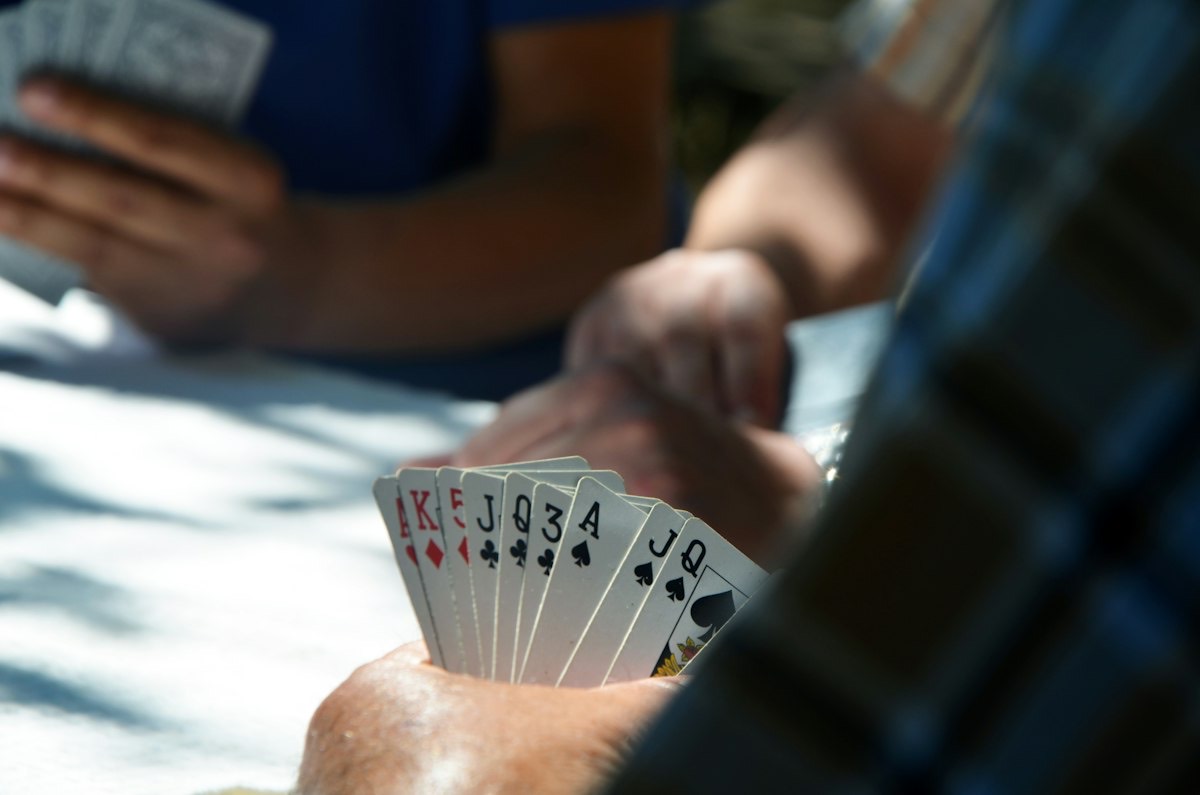
The deal and first turn
Cut for the first deal; the lower card deals. After that, pagat's rules have the winner of each hand deal the next one, while many families have the loser deal. Either works if you agree on it.
Deal 10 cards to each player, one at a time. Turn the 21st card face up to start the discard pile. This first card is the upcard. The rest of the deck goes face down as the stock.
The first turn has a special rule. The non-dealer can take the upcard or pass. If they pass, the dealer can take it or pass. If both pass, the non-dealer starts by drawing from the stock, and play continues normally.
A turn
- Draw: take the top card of the stock, or the top card of the discard pile.
- Discard: put one card face up on the discard pile. If you took the top discard, you can't throw that same card back this turn.
That's all. There's no melding on the table and no laying off during play, which is the big difference from basic Rummy. Everything happens in your hand until someone knocks.
Melds and deadwood
A set is three or four cards of the same rank. A run is three or more cards of one suit in order. Any card can belong to only one meld at a time. Everything else in your hand is deadwood, and its point total is your deadwood count.
When a card could fit two melds, arrange your hand to leave the lowest deadwood. With 7♣︎ 7♦︎ 7♠︎ and 5♠︎ 6♠︎, the 7 of spades can finish the set or the run, but not both.
Knocking
After you draw, if your deadwood would be 10 or less once you discard, you can knock. Knocking is optional: you can keep playing to lower your count or try for gin.
To knock, discard one card face down (many people literally rap the table), then lay your hand out face up, sorted into melds and deadwood. Your opponent then lays out their hand too. They may lay off any of their deadwood on your melds, which lowers their count. The knocker can't lay off on the opponent's melds, and nobody can lay off onto deadwood.
Example: a normal knock
The knocker scores 20 minus 4, which is 16 points.
Going gin
If every card in your hand is in a meld after your discard, you've gone gin. You score a bonus of 20 points plus your opponent's full deadwood count. Your opponent can't lay off on a gin hand, and gin can't be undercut.
If your opponent is left with 31 points of deadwood, gin scores 20 + 31 = 51 points.
Undercuts
If your opponent's deadwood, after laying off, is the same as yours or lower, they've undercut you. They score the difference plus a bonus of 10 points, and you score nothing for the hand.
You knock with 9. Your opponent lays off two cards and ends with 7. They score 9 minus 7 plus 10, which is 12 points. A tie at 9 and 9 would give them 0 plus 10.
Scoring a hand
| Result | Who scores | Points |
|---|---|---|
| Knock, lower deadwood | Knocker | The difference |
| Gin | Knocker | Opponent's deadwood + 20 |
| Undercut (tie or lower) | Opponent | The difference + 10 |
| Stock down to 2 cards, no knock | Nobody | Hand is a draw |
The stock rule: the last two cards of the stock are never drawn. If the player who takes the third-to-last card discards without knocking, the hand ends with no score and the same dealer deals again. Some groups let the other player take that last discard if it lets them knock.
Winning the game
Keep a running total for each player. The first to reach 100 or more wins the game. Then add the bonuses:
- Game bonus: 100 points to the winner.
- Line bonus (also called a box bonus): 20 points for every hand each player won. These are added at the end and don't count toward reaching 100.
- Shutout: if the loser didn't win a single hand, the game bonus doubles to 200. Some groups double the winner's whole score instead.
The final margin is the winner's total minus the loser's, bonuses included. Plenty of families skip the bonuses and just play to 100. That's fine; the bonuses mostly matter if you're keeping a long-running tally.
Hollywood scoring
A house scoring method that runs three games at once. Draw three columns. A player's first hand win goes in game 1. Their second goes in games 1 and 2. From their third win on, each hand goes in all three. Each column ends when someone reaches 100 in it.
Oklahoma Gin
Oklahoma Gin plays the same way, with one twist: the first upcard sets the knock limit for that hand.
- The upcard's value is the most deadwood you can knock with. A 7 upcard means 7 or less. A face card counts 10, so the limit stays at the normal 10.
- An ace upcard means, in most versions, you can only end the hand by going gin.
- A spade upcard doubles the score for that hand, bonuses included.
- The game usually runs to 150 instead of 100.
Some groups also give extra line bonuses for undercuts and gins, doubled again on spade hands. Agree on that ahead of time.
House rules you'll run into
- Bigger bonuses. Some groups use 25 for gin and 20 for an undercut, or 25 for gin, undercuts and line bonuses alike.
- Big gin. Some tables give a larger bonus if all 11 cards in your hand form melds right after you draw, so you go out without discarding. The bonus varies; agree on it first.
- Who deals. Winner deals (pagat's standard) or loser deals. Both are common.
- Ace high. Rare in Gin. The standard is ace low only, worth 1 point.
Strategy
- Knock early when you can. Waiting for gin feels good, but your opponent is improving their hand at the same time. In the early part of a hand, a knock with 8 or 9 usually beats holding out.
- Get rid of high deadwood first. A lone king costs 10 if you're caught. A lone ace costs 1.
- Take the discard only when it melds. Every discard you pick up tells your opponent what you're building. A stock draw tells them nothing.
- Watch what your opponent picks up and passes. If they took the 9 of hearts, don't throw them the 8 or 10 of hearts or another 9. A card they passed is usually safe to throw back to them later.
- Keep connected middle cards. 6-7 of the same suit can become a run with a 5 or an 8. Pairs plus connected cards give you more ways to complete melds.
- Late in the hand, play defense. Once you can't knock soon, cut your deadwood so an opponent's knock costs you less, and think about an undercut.
Gin Rummy on Hangtime
Hangtime doesn't have a Gin Rummy table yet. Rummy on Hangtime plays American Rummy and Indian 13-card Rummy for 2 to 6 players, with the table on the TV and each hand on a phone. For Indian 13-card Rummy with a real deck, the cheat sheet and score keeper runs on one phone.
The table shows on the TV and your hand stays on your phone. Indian 13-card or American Rummy, 2 to 6 players, in the Card Night pack.
Play RummyStart with the free games →Questions
How many cards do you deal in Gin Rummy?
10 cards each. The next card is turned face up to start the discard pile, and the rest of the deck is the stock.
What is the most deadwood you can knock with?
10 points. You can knock once the cards in your hand that aren't in sets or runs add up to 10 or less. In Oklahoma Gin the first upcard sets a lower limit.
How many points is gin worth?
Going gin scores a 20-point bonus plus your opponent's deadwood count. Some groups use 25 for the bonus.
What is an undercut in Gin Rummy?
If you knock and your opponent's deadwood, after they lay off, is equal to or lower than yours, they've undercut you. They score the difference plus a 10-point bonus. Some groups make the bonus 20 or 25.
Can you lay off when someone goes gin?
No. Your opponent can only lay off cards on a knocker's melds after a normal knock. A gin hand can't be laid off on and can't be undercut.
Is the ace high or low in Gin Rummy?
Low only. A-2-3 is a run, Q-K-A is not, and an ace counts 1 point as deadwood.
What happens if nobody knocks before the stock runs out?
When only two cards are left in the stock and the player who drew the third-last card discards without knocking, the hand is a draw. Nobody scores and the same dealer deals again.
What score do you play Gin Rummy to?
100 points is standard. The winner gets a 100-point game bonus, and each hand won adds a 20-point line bonus at the end. Oklahoma Gin usually plays to 150.
Can three people play Gin Rummy?
It's built for two. With three, families often rotate so two play while the third keeps score, or switch to basic Rummy or Rummy 500.